How to Launch a Token in 2026: The Pre-Launch to Post-TGE Marketing Playbook
Most token launches fail not because of bad tech, but because of bad marketing timing and poor narrative positioning. Teams obsess over token creation, smart contract audits, and exchange listings, the obvious checkboxes. But the 90-day marketing runway before and after TGE (Token Generation Event) gets ignored. Messaging goes broad instead of targeting the real
By Juilan Stafford
Co-Founder at Surgence Labs
Introduction
Most token launches fail not because of bad tech, but because of bad marketing timing and poor narrative positioning.
Teams obsess over token creation, smart contract audits, and exchange listings, the obvious checkboxes. But the 90-day marketing runway before and after TGE (Token Generation Event) gets ignored. Messaging goes broad instead of targeting the real buyer and user audience. Community building starts late. Marketing drops off the day after launch.
This Surgence Labs playbook covers the full marketing timeline for those wondering how to launch a token, from narrative positioning to community building to post-TGE retention -based on over 100 successful launches.
Token launches win on timeline discipline: seed narrative and credibility at least 90 days pre-TGE, then run a structured 90-day post-TGE retention plan.
Audience-behavior targeting beats mass broadcasting: segment by capital profile, risk appetite, and motivation, then match channels and messaging to each segment.
Community is infrastructure, not a launch asset: phased access (alpha → beta → public), role systems, and testnet quests build real participants before liquidity arrives.
KOLs should function as educators and validators: vet for authenticity and audience fit, brief with narrative angles, and activate in coordinated waves across tiers.
Measure success on-chain, not on X: prioritize wallet connects, usage, staking, governance participation, retention, and TVL over impressions and likes.
What Is Token Launch Marketing in 2026?
Token launch marketing is the process of identifying your audience, positioning your token’s utility and economics, building trust before capital is deployed, converting attention into participation, and sustaining engagement after launch.
Let’s clarify terms first. A TGE (Token Generation Event) is the moment when your token becomes transferable and is typically listed on exchanges. It’s the successor to ICOs (Initial Coin Offerings), but with critical differences. ICOs were largely unregulated. TGEs operate in a more mature regulatory environment. ICOs promised future utility. TGEs often launch with real usage already happening.
The crypto market has fundamentally changed since 2020. Regulatory frameworks exist now -or at least, regulators are paying attention. In the EU, MiCA introduced uniform rules for crypto-assets and service providers, signalling a more formal regulatory baseline. Global regulators have also published concrete frameworks for crypto market oversight, including IOSCO’s 2023 policy recommendations for crypto and digital asset markets. And on the compliance side, FATF’s guidance on virtual assets/VASPs (including the Travel Rule) reinforces that distribution now sits under real AML/CFT expectations.
Aside from this, market makers are professionalized. Investors see hundreds of token launches annually. Airdrop fatigue is real. Point systems are everywhere. Speculation without narrative doesn’t convert anymore.
What actually works? Building repeatable demand loops, not one-off hype campaigns. A strong token marketing agency creates awareness and engineers the conditions where your audience feels compelled to participate, then stay.
How to Identify the Target Audience for a Token
Most token launches fail at the first step: audience mismatch.
Teams describe their audience as “retail investors” or “the DeFi community” -descriptions so broad they’re useless. A token that appeals to yield farmers will repel governance-focused token holders. A narrative that converts conservative capital won’t resonate with speculators. Distribution channels that work for one segment actively confuse another.
Stop thinking about demographics. Start thinking about behavior.
When you’re figuring out how to launch a token, segment your audience across three dimensions:
1. Capital Profile
Retail users (small capital, high participation, trust-sensitive)
Whale funds (large capital, relationship-driven, due diligence-intensive)
Builders and teams (ecosystem alignment, long-term holding)
On-chain apps: Conversion to action, wallet connection, and real participation
Token launch marketing fails when teams broadcast the same message everywhere. It wins when you target specific audiences through channels they actually monitor, with messages that align with their motivation.
Why Most Token Launches Fail (And What Successful Ones Do Differently)
The top three failure patterns:
1. Launching without a coherent narrative. The token exists to solve a problem, but the team never articulated what that problem is. Investors see tokenomics and tech, but no compelling “why.” Without narrative, you’re fighting for attention against 500 other launches claiming the same generic benefits.
2. Building community too late. Teams finalize tokenomics in month three, launch a Discord in month four, and expect momentum by month six. Community is cultivated. It compounds over time. If your Discord has 2,000 members the day before TGE, most of them joined for the airdrop, not because they believe in your vision.
3. Abandoning marketing post-TGE. Launch happens, price pumps, token sells off, team moves on to “real work.” Post-TGE is when retention mechanics matter. It’s when governance voting drives engagement. It’s when you prove your token has utility beyond speculation. Teams that ship execution updates, activate real staking or governance, celebrate ecosystem wins -those are the projects with staying power.
What do successful launches do differently?
90-day pre-launch runway. Narrative seeded 90+ days before TGE through founder content, media appearances, and early community access. Not launching cold.
Phased community access. Private alpha (testing, feedback) → Invite-only beta (reputation-building, testing at scale) → Public (onboarding waves, not Day 1 chaos).
KOL seeding before public awareness. Vetting influencers 60 days out, briefing 30 days out, activating 14 days before TGE. They become educators and validators, not shillers.
Pre-Launch: Building Trust Before Capital
Pre-launch spans 4-6 months before TGE. The goal is simple: by the time capital is deployed, your audience understands the problem, believes in your solution, and has already proven their commitment through engagement or testnet participation.
Narrative Positioning – Crafting Your Token's Story
Your token solves a real problem. But your audience doesn’t know what that problem is yet.
Develop two distinct narratives:
For retail audiences: Focus on tangible benefits. What does the token do for a user? If it’s a DeFi token, maybe it’s “earn sustainable yield without liquidation risk.” If it’s gaming, it’s “own your progression across multiple games.” Make it concrete.
For institutional audiences: Focus on economics, scarcity, and network effects. What’s the macro thesis? Why will this token capture value? What’s the competitive moat? Institutions want thesis clarity and defensibility.
Finalize your narrative 90+ days before TGE. Then seed it relentlessly -through founder content on X, media appearances on Bankless or podcasts, early community educational threads, partnerships with media platforms like Kaito or The Block.
Your narrative can’t change three weeks before launch. It needs to be baked into culture by then.
Tokenomics Design That Supports Marketing Goals
A steep vesting schedule on team tokens says “we’re not selling into you.” A community allocation that’s actually spent on ecosystem grants says, “We’ll fund builders.” Airdrop reserves signal generosity. Emissions curves that tail off signal scarcity concerns.
When designing tokenomics, ask:
How does the vesting schedule affect sell pressure narratives?
Does our community allocation justify marketing claims about decentralization?
Are we setting aside resources for ecosystem incentives and KOL rewards?
Does our airdrop strategy reward long-term participation or just show up time?
Marketing and tokenomics should be designed in tandem, not separately.
Web Presence, Brand Identity & Compliance
Your web presence is your first professional impression. Essential assets:
Token landing page. Problem statement, solution, why the token matters, how to participate, tokenomics at a glance.
Countdown page. TGE date, exchange listing partners, how to participate, and FAQ.
Brand identity should be consistent across all channels. Visual system (logo, color, typography), messaging hierarchy (mission, value props, proof points), social media templates.
And 2026 requires compliance. Get legal counsel. Understand how your token might be classified (utility, security, commodity). Draft marketing disclaimers. Know geographic restrictions. Compliance is foundational.
Community Building – Discord & Telegram Phased Growth
Communities are built in phases, not launched all at once.
1. Closed Alpha (target: 500 members)
Invite-only. Early believers, technical users, partners, and advisors.
Channels: announcements, feedback, alpha testing, and direct access to the team.
Goal: gather feedback, refine messaging, and identify potential evangelists.
2. Invite-Only Beta (target: 5,000 members)
Still gated. Ambassador program members, tested community members, and ecosystem partners.
Channel expansion: announcements, general discussion, governance, regional channels, support.
Goal: test community management infrastructure, surface edge cases, build reputation as responsive and real.
3. Public (target: 10,000+ members)
Open Discord. Heavy moderation. Clear rules. Tiered access based on participation.
Ambassador programs launch at scale with tiered incentives.
Channel architecture matters. Announce-only channels reduce noise. Role-based access (contributors get a #builders-only room) rewards participation. Regional channels expand globally without spam.
Testnet campaigns are your proving ground. Create quests: deploy a contract, vote on governance, stake tokens (on testnet), bridge assets, trade. Reward with points that convert to an airdrop allocation. You’re filtering for real participants.
KOL Seeding – How to Vet, Brief, and Activate Crypto Influencers
Most projects treat KOLs like ad channels. “Here’s $10K, talk about us.” Then they wonder why engagement is low.
Real KOL activation is a system.
Timeline:
60 days before TGE: Identify 60-80 potential KOLs. No outreach yet. Just research.
45 days before TGE: Run credibility checks. Check their on-chain history, wallet transparency, audience demographics, engagement quality, and potential conflicts.
30 days before TGE: Brief the chosen KOLs. Walk them through your narrative, tokenomics, and distribution mechanics. Answer hard questions. Get their authentic take -not canned feedback.
14 days before TGE: KOLs activate. Not all at once. Stagger across the final two weeks. Some go wide (macro KOLs for legitimacy), some explain mechanics (mid-tier educators), some repeat the message (micro for saturation).
Vetting criteria:
On-chain credibility (wallet transparency, participation history, not just followers)
Audience overlap (do their followers match your target segments?)
Engagement quality (comments and real discussion, not vanity metrics)
No conflicts (they’re not shilling a competing project)
Mid-tier creators (10K-100K followers): Explanation and education. Threads, videos, deep-dives.
Micro influencers (1K-10K followers): Repetition and penetration. Staggered content over two weeks.
One would think that success here is measured in impressions. No, good success metrics these days are wallet connections, Discord joins, referral code usage, and on-chain actions (staking, voting, trading).
Airdrop Strategy – Drops That Drive Retention, Not Dumps
The modern airdrop is a retention mechanism.
Design principles you should take note of include:
Engagement-based eligibility. Reward testnet participation, Discord activity, governance voting, and social sharing. Move beyond simple “hold this other token” requirements.
Sybil filtering. Use wallet age, transaction history, on-chain reputation, and phone verification. Bots are your enemy.
Vesting schedules. Don’t dump all tokens on Day 1. Linear vesting over 3-6 months aligns incentives. It reduces immediate sell pressure.
Points systems. Tradeable or non-tradeable points that convert to airdrop allocation create engagement loops. Users see their progress. They’re invested in reaching higher tiers.
Lock-up bonuses (if you hold for 3 months, get 20% more). Reduces dumping.
Governance participation requirements (vote on 3 proposals, unlock 25% of your allocation). Forces engagement with utility.
The worst airdrops spray tokens at everyone with no conditions. The best airdrops design governance participation into eligibility.
What Content Resonates Most With Token Audiences?
Not all content is equal. Three categories actually move the needle.
1. Narrative Content Explains why the token exists, what problem it solves, and why now. Founder threads on X. Long-form explainers. Interviews. This is your “why.” It should answer: “What was broken before, what’s different now, why will this token matter in 2028?”
2. Translation Content Turns complex mechanics into mental models. Tokenomics breakdown videos. “How to stake” guides. Governance voting tutorials. Your audience isn’t all technical. Translation content democratizes access.
3. Proof Content Real users, real activity, real metrics. Screenshots of growing TVL. Leaderboards of top traders. Testimonials from ecosystem partners. Numbers from on-chain dashboards. Proof is the antidote to hype fatigue.
The best token launch agencies excel at simplifying complexity. They take your tokenomics and translate it into: What does a user do? What do they get? What changes over time? If you can’t explain it in 30 seconds, your content isn’t resonating.
Do Reward Tokens and Gamification Actually Work?
Yes. With caveats.
Gamification works when incentives feel earned. When a user grinds a quest and earns 10 points, they value it more than 10 points handed out freely. Behavioral psychology proves it.
High-performing mechanics:
Role-based Discord access. Contributors get a #builders channel. Governance participants get a voting room. Status is exclusive and tied to behavior.
XP systems are tied to real actions. Not just “joined Discord (+1 XP).” Real actions: deployed a contract, voted on governance, referred a friend, and staked tokens.
Leaderboards with real allocation. Top 100 contributors get an extra airdrop allocation. Everyone can see the leaderboard. It drives competition.
Non-transferable badges. “Governance Architect” badge shows you’ve voted on 50 proposals. Can’t be bought or gamed. Pure signal.
Testnet-to-mainnet progression. Users earn on testnet, see their score, and know they’re proving their commitment before mainnet launch.
The insight: people value rewards more when they feel deserved. Gamification doesn’t increase participation by making things fun. It works by aligning incentives and making effort visible. Design it right, and your community self-selects for commitment.
Best for: early-stage projects, community-driven launches, rapid market testing
Decision framework:
Your stage: If you’re a Series B-funded team with institutional investors, CEX listing drives credibility. If you’re an early-stage, bootstrapped startup, a DEX launch gets you to market faster.
Your audience: If your narrative targets retail masses, CEX is mandatory. If your community is crypto-native and sophisticated, DEX works.
Your budget: Institutional rounds can support CEX costs. Smaller teams need to choose strategically.
Most successful launches use both: DEX on launch day for immediate liquidity, CEX within 30 days as a secondary step.
Launch-Day Communications and Amplification
Launch day should feel coordinated, not chaotic.
Hour-by-hour framework (assuming 12 pm UTC launch):
9 am – 11 am: Countdown threads from founders and partners. Excitement without instruction.
11 am – 12 pm: Live AMA or Twitter Space with the team. Q&A. Human connection. Address concerns.
12 pm: Token goes live. Press release goes out simultaneously. All social channels fire. KOLs post. Pre-written media coverage appears (embargoed until now).
12 pm – 2 pm: Real-time community management. Discord and Telegram are live with the team visible. Celebrate milestones: $X TVL hit, Y,000 wallets connected, Z exchange listed.
2 pm – 6 pm: Sustained amplification. Staggered partner tweets. Second-wave KOL posts. Educational content (how to stake, how to vote, how to bridge).
Coordination is everything. A press release that goes out before X posts is wasted. A KOL activation that happens before the team is awake to respond kills momentum. Synchronize.
Transparent communication matters. “Token listed. TVL is $50M. $300K in the first hour. Next: governance voting.” Real-time updates beat silence.
Navigating Crypto Advertising Restrictions
Meta, Google, and TikTok all restrict crypto advertising. This is the constraint you work within.
Paid ads still matter. The foundation is:
Organic influencer distribution. KOLs post authentically. No paid ads needed.
Owned communities. Discord, Telegram, and email list. You own the channel. No restrictions.
Earned media. Press coverage, podcasts, and interviews. Journalists amplify.
Content syndication. Educational content on platforms like Mirror, Substack, and Medium.
When ads are used:
X retargeting. Remarketing to engaged followers. Lowest friction crypto-native platform.
Crypto-native ad networks. Coinzilla, CoinMarketCap native ads, Messari Crypto. Platforms built for this.
Seasonal points. New quests every quarter. New reasons to engage. Prevents staleness.
Retention is hard. It’s easier to hype a launch than to build lasting mechanics. Projects that invest in post-launch infrastructure beat those that don’t.
Which KPIs Matter in Token Marketing?
Measure what matters. Ignore vanity metrics.
Real KPIs:
Wallet-to-user conversion. Out of X wallets connected, how many are actually using your protocol? If 10,000 wallets are connected but 2,000 are actively staking, you have a 20% activation rate. That’s your real baseline.
Active community members. Not Discord members. Active participants. People voting in governance, commenting on threads, staking, and trading.
CAC vs. long-term participation. How much did you spend per user? What’s their lifetime value (staking rewards, governance participation, fees paid)? If you spend $100 to acquire a user who generates $10 in value, your model isn’t sustainable.
Staking/usage rates. What % of supply is staked? What % participates in governance? These determine if your token has real utility post-hype.
Post-launch retention. What percentage of Day 1 holders still hold 30, 60, 90 days later? This predicts long-term viability.
Sell pressure vs. lock-ups. What percentage of the supply is unlocking monthly? Is it sustainable, or do you face a cliff? Transparency here builds trust.
Dashboards combining data:
The best token projects track three data streams: social (X followers, Discord activity), community (active members, governance participation), and on-chain (holder distribution, trading volume, TVL, staking rates). One dashboard that updates daily beats scattered reports.
Common Token Launch Marketing Challenges (and How to Solve Them)
If you’re learning how to launch a token, here are some common challenges you might face:
Low Adoption
Problem: Token has low usage despite high price.
Root cause: Utility wasn’t clear, or the token doesn’t actually solve a problem.
Solution: Reframe narrative. Show real use cases. Activate actual utility mechanics.
Regulatory Uncertainty
Problem: The team makes vague claims about the token that could be problematic.
Root cause: Legal hasn’t been consulted. Marketing goes too far.
Token launches are judged fast. Narratives matter, but the market rewards proof: participation, retention, and post-TGE utility. These examples show how positioning, incentives, and community mechanics can turn attention into on-chain behavior.
Case Study 1: Falcon Finance ($FF) – From Zero to ~$6B Peak FDV
Background: DeFi infrastructure token for universal collateral protocols.
Challenge: Crowded DeFi market. Skepticism about emissions. 2024 showed that launches without real usage get punished.
Strategy: Proof-of-participation approach. X mindshare via Kaito-indexed InfoFi campaigns. Yap-to-Earn mechanics (tweet, earn points). Discord bot infrastructure for Miles tracking and staking boosts. Badge systems tied to governance participation. Buidlpad sale orchestrated for ecosystem alignment.
Results:
~$112M committed in sale (28x oversubscribed)
~$2.1B FDV at TGE
~$6B peak FDV within weeks
75% of the circulating supply staked in Week 1
$400M+ TVL sustained post-launch
Key insight: Participation metrics drove adoption. Users bought $FF, staked it, voted in governance, and became evangelists.
Case Study 2: OVERTAKE – Gaming TGE to $500M+ FDV
Background: Web3 gaming infrastructure and progression layer.
Strategy: Positioned token as an access and progression layer. Quest-driven onboarding that tied to real gameplay. XP earned from in-game actions. Creator-led tutorials teaching tokenomics. Staggered utility reveal (staking Month 1, governance Month 2, revenue share Month 3).
Sustained creator inbound due to clarity around tokenomics
Key insight: Gaming tokens fail when they’re separate from gameplay. OVERTAKE won because staking and participation were part of the core experience.
Case Study 3: $LAB (LAB Labs) – Infrastructure Token to ~$500M FDV
Background: Infrastructure and ecosystem token for the LAB Labs ecosystem.
Challenge: Technical user base. Abstract benefits. Long timelines. Hard to explain to non-technical users.
Strategy: Segmented messaging for builders, ecosystem partners, and capital allocators. Technical explainers for relevant segments. Proof-based storytelling (screenshots, metrics). Early contributor recognition. Ecosystem-first messaging over token-first.
Results:
~$500M FDV
Strong ecosystem credibility (builders and protocols trust the team)
High signal-to-noise in the community
Key insight: Segmentation works. Different audiences need different narratives. $LAB succeeded by matching the message to the segment.
Patterns Across Successful Token Launches
1. Incentives Were Earned, Not Sprayed. The best communities don’t hand out tokens. They reward participation, then convert participants into long-term holders.
2. Marketing Was Measured in Capital & Actions Not impressions or followers. Real metrics: wallet connections, governance participation, staking rates, TVL. If it can’t be measured on-chain or in your Discord bot, it’s not a real signal.
3. Communities Were Built Before Tokens. The launches that succeeded had 5,000+ active community members before TGE. The launches that failed launched with cold Discord. Community compounds over time.
4. Surgence Operated as an Extension of the Core Team. High-performing agency relationships go beyond transactions. We embed with your strategy and build alongside your team. And we make sure to understand your traction, your constraints, and your vision. Then we advise, we execute, and we iterate based on feedback.
Your internal team lacks bandwidth. Token launches require simultaneous work across narrative, community, content, KOLs, PR, and on-chain mechanics. Most teams can’t do all of this alone.
Your exchange listing requirements are complex. Tier-1 CEX listings require experienced negotiation and market maker relationships.
You need KOL access. Building credibility with 60+ crypto influencers takes years or institutional relationships.
You want to repeat. If you’re planning a token launch every 18 months, an agency becomes a leverage point, not a cost.
The best agencies understand token economics, design incentives responsibly, measure what matters, build trust before capital, and continue optimizing after launch.
The Modern Token Launch Playbook
Crypto token marketing in 2026 is about credibility, systems, and execution.
The best token launches answer a single question: “How do we build a system people want to stay inside?” That is modern token marketing.
Not “How do we hype the launch?” Not “How do we get the highest FDV?” But “How do we design economics, mechanics, and community that align incentives and drive long-term participation?”
That’s where the real value lives.
If you’ve been wondering how to launch a token and want to map your pre-launch to post-TGE strategy, book a token launch strategy call with Surgence Labs. We’ll map your timeline, identify your audience, and build a go-to-market plan based on what’s actually worked across 50+ launches.
FAQs on How To Launch A Token
How long does it take to launch a token?
From concept to TGE, plan for 6-8 months if you’re doing it professionally. Narrative research (1 month), community build (2 months), content and KOL activation (2 months), final execution (1 month), then launch. You can compress this, but 6-8 months allows for testing and iteration. Shorter timelines increase risk of messaging gaps and community readiness issues.
What is TGE, and how does it differ from ICO?
A TGE (Token Generation Event) is when a project creates and distributes its token, making it live on-chain and entering circulation. An ICO (Initial Coin Offering) is a fundraising model that was common in 2017–2018, which involved selling tokens to raise capital, often before a product existed. TGEs are broader, structured, and more utility-driven.
How much does it cost to market a token?
Professional token launch marketing typically ranges from $100K-$300K total (pre-launch through post-launch optimization). Pre-launch costs $30K-$80K. Launch costs $50K-$150K. Post-launch costs $20K-$60K. These budgets cover community infrastructure, KOL partnerships, content, PR, and analytics. Larger projects may spend $500K+.
What are the best exchanges to list a new token on?
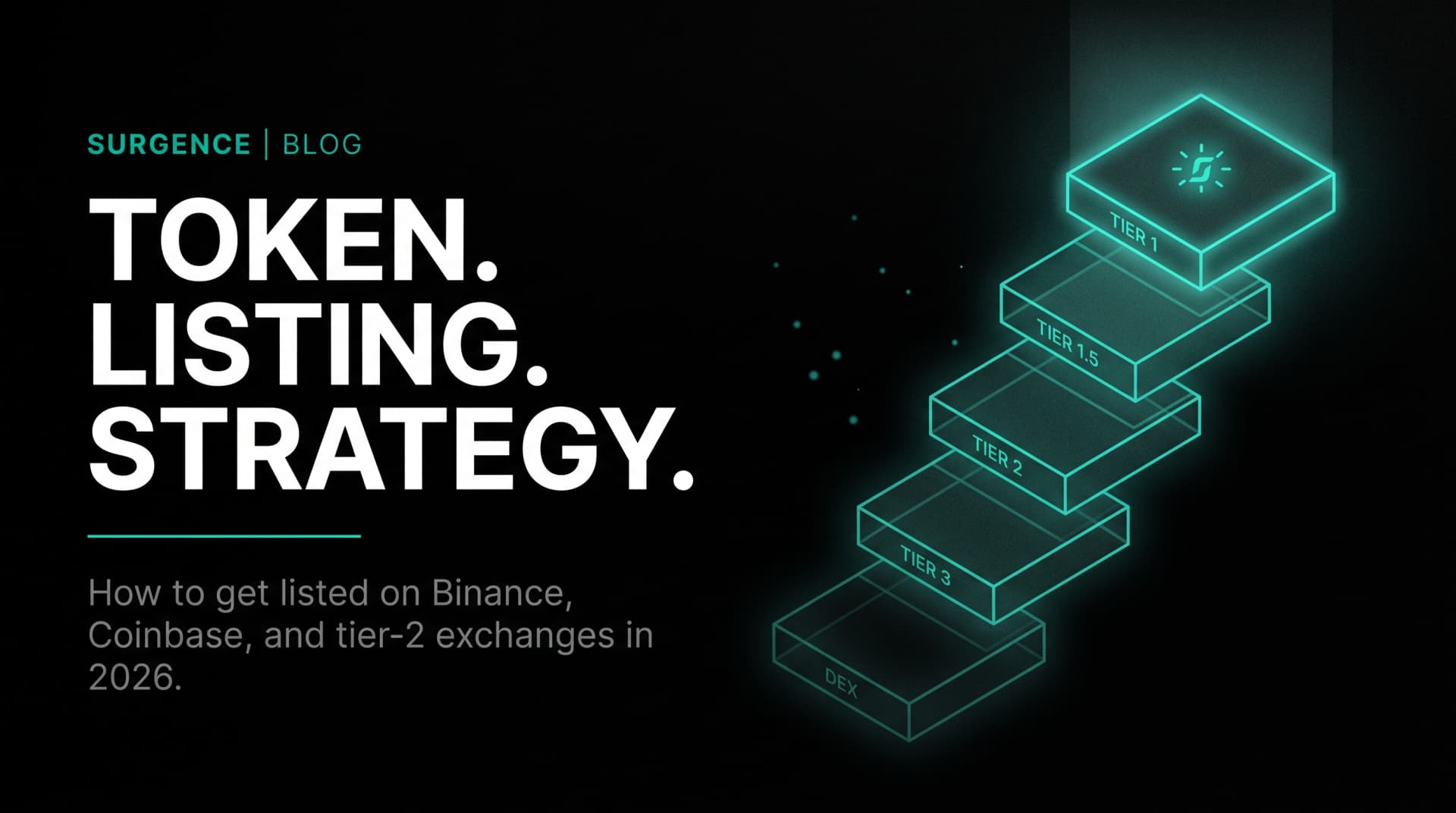
Tier-1 CEX listings (Binance, Coinbase, Kraken) offer maximum legitimacy and retail accessibility but require $100K-$1M+ and 60+ days. DEX launches (Uniswap, Curve) are permissionless and immediate but have lower initial liquidity. Most successful launches use both: DEX on Day 1, CEX within 30 days. Your audience and budget determine priority. Community-driven projects often succeed with DEX-only launches.
How do you prevent a token dump after launch?
Design retention mechanics through staking rewards that offset sell pressure, governance participation that locks tokens in voting contracts, structured vesting schedules for large holders, and revenue-sharing programs that reward long-term holding. Pair this with transparent communication about unlocks, consistent usage milestones, and ecosystem expansion updates that create real utility and reasons to stay engaged.
When should token marketing start before TGE?
Start 6 months before TGE. The first two months are for narrative research, audience mapping, and competitor analysis. Months 2 and 4 are for community building (invite-only phases), KOL vetting, and content creation. Months 4 to 5 are for KOL activation, PR seeding, and Discord expansion. Month 6 for amplification into launch. Shorter timelines work but require agency experience and pre-built infrastructure.
Do you need a marketing agency for a token launch?
A token marketing agency is highly recommended when your internal team lacks bandwidth, when you do not have strong KOL relationships, when you need tier-1 CEX support, and when you want to scale while avoiding expensive learning cycles. Agencies bring patterns from 50+ launches, audience networks, credibility with exchanges, and accountability tied to KPIs. Venture-backed teams or projects with complex tokenomics tend to benefit most.
What are the biggest risks in token launches?
Big launch risks include narrative misalignment, where the token solves a problem the market ignores. Timing risk appears when community building starts late or momentum drops post-TGE. Regulatory risk comes from vague utility claims. Tokenomics risk includes vesting cliffs and unlocks that drive sell pressure. Execution risk is slow shipping that erodes trust.
What's next
Want to talk strategy?
Book a call with the team. No pitch deck required.
Continue Reading
Explore more insights and strategies from Surgence Labs
How to Launch a Token in 2026 | Complete TGE Marketing Guide